Colorado Legislative Malpractice
When Ideology Replaces Stewardship, the Patient Doesn’t Recover — It Declines

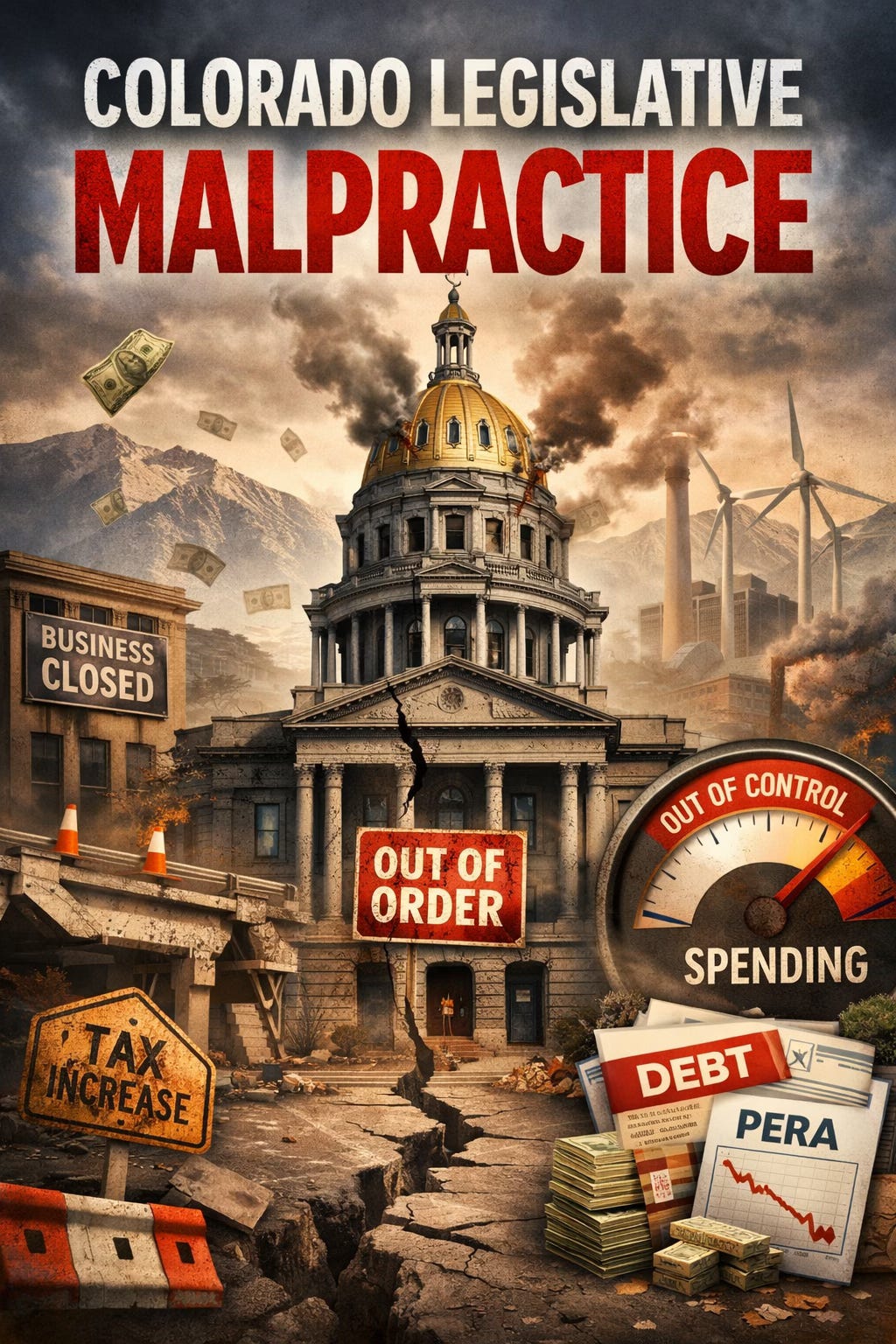
There is a reason malpractice carries such moral weight in medicine. A physician is entrusted with the care of a patient. When that trust is violated—through negligence, arrogance, or ideological blindness—the consequences are not abstract. They are physical, measurable, and often irreversible.
What we are witnessing in Colorado today is a different form of malpractice. Not medical, but legislative.
The patient is the state itself—its economy, its infrastructure, its fiscal health, and ultimately, its people. And the pattern is becoming increasingly difficult to ignore: policies enacted not in service of long-term stability, but in pursuit of short-term ideological satisfaction. The result is a slow but steady deterioration masked by surface-level prosperity.
Colorado still looks healthy. But the symptoms are beginning to show.
The Quiet Flight of Employers
Healthy economies are built on production—on individuals and organizations that create value, employ others, and generate the tax base upon which everything else depends. When those producers start leaving, something is wrong.
In recent years, Colorado has cultivated a reputation that should concern anyone serious about economic sustainability: it is becoming a difficult place to do business.
This is not the result of a single policy, but of an accumulation of them. Expanding labor mandates, aggressive regulatory frameworks, and a growing reliance on unelected boards to dictate industry standards have created an environment where predictability—the lifeblood of investment—has been replaced by uncertainty.
Small and mid-sized businesses, in particular, feel this pressure most acutely. Large corporations can absorb compliance costs. Local employers cannot. When margins shrink and regulatory burdens grow, the decision becomes less philosophical and more practical: stay and struggle, or leave and survive.
And increasingly, they are choosing the latter.
This is how decline begins—not with a dramatic collapse, but with a gradual erosion of the productive class.
PERA and the Mathematics of Avoidance
If there is a single issue that best illustrates Colorado’s long-term fiscal vulnerability, it is the Public Employees’ Retirement Association (PERA).
For decades, PERA has operated under assumptions that would not survive scrutiny in the private sector. Promised benefits have outpaced realistic returns. Contributions have been politically constrained. And reforms, when attempted, have often been partial, delayed, or reversed.
The result is a system carrying tens of billions in unfunded liabilities.
This is not merely an accounting problem. It is a moral one.
Every dollar required to sustain an underfunded pension system is a dollar that cannot be used for roads, schools, or public safety. More importantly, it represents a transfer of obligation from the present to the future—from those who made the promises to those who will be forced to keep them.
In a household, this would be called living beyond one’s means. In government, it is too often called policy.
Fees as Taxes: The Erosion of Accountability
Colorado’s Taxpayer’s Bill of Rights (TABOR) was designed to impose discipline—to ensure that increases in government revenue required the consent of the governed.
But when direct taxation becomes politically difficult, the incentive shifts. If you cannot raise taxes, you redefine them.
Thus, the rise of “fees.”
Transportation fees. Environmental impact fees. Regulatory fees. Enterprise fees.
Each one justified on narrow grounds. Each one presented as distinct from taxation. Yet collectively, they function in precisely the same way: extracting resources from the public to fund government activity.
The distinction is not economic. It is semantic.
And the effect is corrosive.
When revenue can be increased without voter approval, accountability diminishes. When accountability diminishes, spending expands. And when spending expands without constraint, structural imbalance follows.
This is not a loophole. It is a strategy.
Infrastructure: The Visible Cost of Misplaced Priorities
If fiscal mismanagement is often hidden, infrastructure reveals it.
Colorado drivers do not need a budget report to understand that something is wrong. They experience it daily—in congestion, in deteriorating road conditions, in projects that seem perpetually incomplete.
Billions have been collected in the name of transportation. Yet the outcomes rarely match the promises.
Why?
Because infrastructure has increasingly become secondary to ideology.
Funds intended for road capacity are redirected toward transit experiments with limited utilization. Maintenance is deferred in favor of new initiatives that align with broader policy goals. The practical is subordinated to the aspirational.
The result is predictable: a system that costs more and delivers less.
Infrastructure is not merely about convenience. It is about economic function. When goods cannot move efficiently, when commutes become unpredictable, when costs rise across the board, the entire economy feels it.
This is how policy decisions translate into lived experience.
Energy Policy: Reliability Sacrificed to Narrative
Nowhere is the tension between ideology and reality more pronounced than in energy.
Colorado has pursued an aggressive transition away from traditional energy sources, driven by climate objectives that, while politically compelling, often ignore the practical requirements of a modern grid.
Baseload power—reliable, continuous energy—is not optional. It is foundational.
Yet policies have systematically constrained or eliminated sources capable of providing it, while promoting alternatives that remain intermittent and dependent on conditions beyond human control.
The promise is that technology will bridge the gap. The reality is that, today, it has not.
The consequences are already emerging: higher costs for consumers, increased strain on the grid, and the loss of high-paying energy jobs that once anchored local economies.
This is not an argument against innovation. It is an argument against pretending that aspiration can substitute for physics.
The Expanding State and the Illusion of Sustainability
Overlaying all of this is a broader pattern: the steady expansion of government obligations.
New programs are introduced with compelling narratives—addressing housing, healthcare, education, equity. Each one framed as necessary. Each one difficult to oppose without appearing indifferent.
But necessity does not eliminate cost. It only obscures it.
What is rarely addressed is how these obligations will be sustained—not in the first year, or the second, but over decades.
Temporary surpluses, often driven by economic cycles or federal transfers, create the illusion of capacity. But they do not change the underlying trajectory.
And that trajectory is clear: obligations are growing faster than the systems designed to support them.
This is the essence of fiscal instability.
A Familiar Path
None of this is unprecedented.
States that have followed similar paths—expanding obligations, constraining production, bypassing fiscal constraints—have arrived at similar outcomes: rising costs, declining competitiveness, and, eventually, crisis.
The early stages are always the same. Growth masks imbalance. Revenue temporarily keeps pace with spending. Warnings are dismissed as partisan or alarmist.
Until they are not.
Colorado is not yet at that point. But it is moving in that direction.
Malpractice Is Not Intentional — But It Is Preventable
It is important to be clear about what is being argued here.
Legislative malpractice does not require malice. It does not assume bad intentions. In many cases, the policies in question are motivated by a genuine desire to improve outcomes.
But good intentions do not guarantee good results.
When decisions consistently ignore economic incentives, fiscal constraints, and operational realities, the outcome is the same regardless of intent.
The patient declines.
The Need for a Course Correction
What would it look like to move in a different direction?
It would begin with a reorientation toward first principles:
Production before redistribution
Sustainability before expansion
Accountability before creativity in revenue generation
Reality before ideology
It would require confronting long-term liabilities honestly, even when politically inconvenient. It would mean respecting the structural constraints imposed by measures like TABOR, rather than searching for ways around them.
And it would involve a renewed focus on the fundamental responsibilities of government: maintaining infrastructure, ensuring public safety, and creating an environment in which individuals and businesses can thrive.
These are not radical ideas. They are foundational ones.
Conclusion: The Window Is Still Open
The defining characteristic of malpractice is not just the harm it causes, but the fact that it could have been avoided.
Colorado is not beyond repair. Its strengths remain considerable—its workforce, its geography, its entrepreneurial spirit.
But strengths, left unmanaged, do not sustain themselves.
They must be protected. And that requires discipline.
If malpractice in medicine threatens the life of the patient, legislative malpractice threatens the life of the state—not in a single moment, but over time, through a series of decisions that, taken together, move steadily in the wrong direction.
The question is not whether Colorado can recover.
It is whether its leaders will recognize the diagnosis before the condition becomes irreversible.
Michael, Great article, as always, but do we realize the amount of effort which would be required to bent back if not reverse these numerous bad ideas that have been foisted on us? Colorado is very sick and getting more sick with every election and legislative act.
You're absolutely right. In my early 20s I was sent on business to Memphis. In my free time, I walked downtown and became increasingly alarmed at how vacant it was. I didn't understand how a whole city with all the structures and infastructure didn't have any business to occupy them. Where did all the business go? It's not like an outdated factory closed up like in some places. This was once a busy downtown. The formula for exactly how and why are written right here. This line on your post hit me the most :"A transfer of obligation from the present to the future—from those who made the promises to those who will be forced to keep them."